
 EN
EN
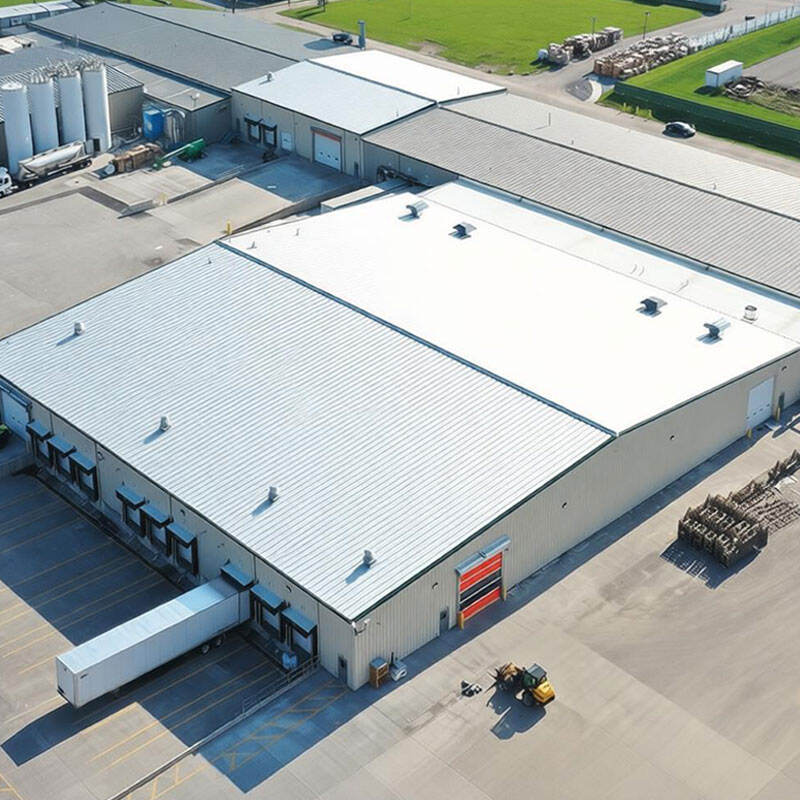
People often assume concrete means strength. It feels solid, it looks immovable, and on a quiet day, it seems like the safest thing you could stand next to. But the moment you put a concrete structure into an earthquake or a hurricane, you start to see where that logic falls apart. A steel building does not just survive those conditions on paper. The reason it works better in real world extreme events comes down to a few physical behaviors that are hard to notice until you watch both materials go through something serious.
How steel handles ground motion by moving with it
Think about what happens when the ground shakes. If you build something incredibly stiff and rigid, it has no way to release the energy coming up from the foundation. Every crack and every jolt travels straight up through the structure until something snaps. Steel behaves differently because it has ductility, a property that lets it stretch, bend, and deform a little before it fails. That means during a seismic event, a steel structure absorbs energy by deforming elastically, not by shattering. Concrete is strong in compression, but it is brittle. Under the same shaking, it tends to crack and spall, which then exposes the reinforcement and starts a chain of damage that is much harder to stop.
Another key detail is how forces travel through a steel building. The connections between beams and columns are often welded or bolted in a way that allows slight rotation without losing overall stability. Those joints act almost like hinges that relieve local stress rather than concentrating it. In a concrete moment frame, the joints are monolithic, so stress just builds until the section reaches its limit. That is the difference between a frame that dances with the ground and one that fights it.
The role of weight when the wind blows
Wind load is not just about how hard the air pushes. It is also about how much mass the building has and how that mass interacts with the lateral force. A heavier structure has more inertia, and when a gust hits, that inertia keeps the building moving in the direction the wind pushes, which can amplify the sway if the damping is not enough. A steel building is lighter than an equivalent concrete one, which actually helps under high wind conditions. Less mass means less momentum once the wind starts acting on the facade. Combine that with the stiffness you can achieve with a well braced steel frame, and the building tends to deflect less overall and return to center faster.
Concrete is heavy. That mass does help in some scenarios, like resisting uplift, but when the wind is gusting at 150 miles per hour, that same weight becomes a problem. A concrete structure can develop uncomfortable drift and resonance issues if it is not tuned perfectly. Steel gives you more flexibility to stiffen the frame where you need it, add bracing elements, and tune the dynamic response without fighting the dead weight.
Why brittle materials struggle in both scenarios
To understand why a steel building outperforms concrete, you have to look at failure modes. Steel typically gives you warning before it fails. You see deformation, you hear noises, and there is time to react. Concrete fails suddenly. Once a crack propagates through a critical section, the whole component can lose capacity almost instantly. During an earthquake, that difference is huge. A steel frame might lean or drift but stay standing long enough for people to get out. A concrete shear wall that cracks through loses most of its lateral resistance in that moment, and the building can experience a partial collapse without much warning.
The same applies in wind events. Wind gusts are repetitive. They hammer a building over and over. Steel can handle millions of load cycles without fatigue failure because the stress levels stay below the endurance limit. Concrete, especially when it has microcracks from previous loading, can degrade over time under repeated wind cycles. What starts as a hairline crack becomes a water path, then corrosion starts, and eventually you lose section. The damage is cumulative in a way that is hard to inspect and hard to repair.
How steel structures dampen energy naturally
There is something about how a steel building is assembled that creates built-in damping. Bolted connections have a small amount of friction. Braced frames have members that go into tension and compression, and each cycle dissipates a little energy through hysteresis. None of this is dramatic, but it adds up. When an earthquake hits, that energy has to go somewhere. In a concrete structure, much of the energy goes into cracking the material, which is permanent damage. In a steel building, more of it gets dissipated through the structural system itself, so the frame takes less cumulative punishment.
Wind behaves similarly. Gusts load and unload the cladding, and that energy travels through the girts and purlins into the main frame. A steel building with properly designed bracing turns that into a repeating low-stress cycle that the material handles naturally. Concrete elements, especially thin ones, do not love repetitive lateral loading. The bond between the reinforcement and the concrete slowly degrades, and the stiffness of the section drifts over the years.
The advantage of flexibility in design and connection detailing
One practical difference is how easy it is to add specific seismic or wind resisting elements to a steel frame. You can design a bracing configuration for the exact wind direction that matters for your site. You can add moment frames in one direction and braced bays in another. You can use base isolators with a steel superstructure and get excellent results because the light weight lets the isolators work efficiently. Concrete tends to lock you into a limited set of lateral systems, and modifying them later is messy and expensive. With a steel building, the connection details are standardized, and you can verify them with straightforward calculations. That means the design can be more precisely tuned to the actual hazard level, which makes the building both safer and more economical.
What this means for owners in seismic and wind zones
If you are looking at building in a place where earthquakes or high wind are a regular concern, the choice of structural material is not a small decision. A steel building gives you a predictable, ductile, and lightweight system that handles lateral loads without accumulating hidden damage. Repairs tend to be simpler because you can replace or reinforce individual members without tearing into massive concrete sections. And the long term behavior, especially under repeated loading, is more consistent.
That is not to say concrete has no role. But when the question is specifically about performance in seismic and wind load scenarios, the evidence leans heavily toward steel. Less mass, more ductility, stronger connections, and a failure mode that gives you warning rather than surprise. That combination is hard to match, and it is the reason why so many projects in high hazard regions now default to a steel building as the primary structure.